When Did Theatre Begin Again in Church Services
Staging in the Medieval Age
Medieval theatre refers totheatrical performance in the menstruation betwixt the fall of the Western Roman Empire in the 5th century A.D. and the get-go of the Renaissance in approximately the 15th century A.D.
Due to a lack of surviving records and texts, a low literacy rate of the general population, and the opposition of the clergy to some types of performance, there are few surviving sources on Medieval drama of the Early and High Medieval periods. However, by the late period, drama and theatre began to become more secularized and a larger number of records survive documenting plays and performances.
From the 5th century, Western Europe was plunged into a menses of full general disorder that lasted until the 10th century A.D. As such, most organized theatrical activities disappeared in Western Europe.
Depending on the expanse of the performances, the plays were performed in the middle of the street, on pageant wagons in the streets of great cities (this was inconvenient for the actors because the small stage size made stage movement incommunicable), in the halls of nobility, orin the round in amphitheatres, equally suggested by electric current archæology in Cornwall and the southwest of England.
The most detailed illustration of a mystery play phase design is the frontispiece to Hubert Cailleau'sThe Passion and Resurrection of the Savior. All medieval stage product was temporary and expected to be removed upon the completion of the performances. Actors, predominantly male, typically wore long, dark robes.
Medieval Staging:
Two major kinds of stages in the medieval theatre:Stock-still and Moveable.These technical tricks would be more extensive on fixed stages. The mansion and platea were borrowed from the church building services. Simultaneous display of several locations also borrowed from liturgical drama- Simultaneous staging was a distinctive characteristic of medieval theatre.
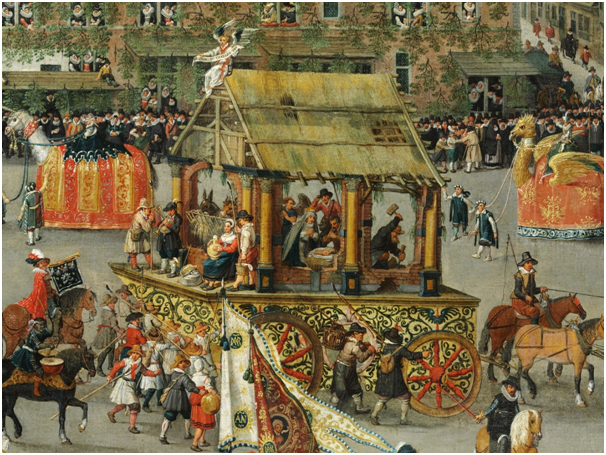

Medieval Theatre came to life on two different stages: The Fixed(Stationary) Phase, and thePageant Railroad vehicle.
The Fixed Stage consisted of a largemansion, which served as dissimilar locations and scene changes for during the plays. Sky and Hell were the two opposite realms identified by the ii opposite sides of the phase. Theplatea was the acting area (the Roman equivalent of theskene in Greek Theatre), adjacent to the mansion. Actors could be lifted and lowered off phase using what was then considered exemplary machinery such equally trap doors, burn, and flying techniques.
On the other hand,pageantswere the more physical stages that were maneuvered using wagons. Their platforms could hold several actors as well as minimal props such as chairs and tables. The upside: They would attract large masses of audiences in outdoor markets and festivals who could investigate the scene as they passed by, the downside was that Actors needed to brand an extra attempt to hibernate when it wasn't their scene.


Before long these stationary stages began to change. Phase structure shortly took a turn to something different, "pageant wagons," which were basically minor stages placed on a wheeled wooden cart. This new type of phase changed the number of people who could view the plays, instead of people having to travel to the church to see the play, the stage and the play could now come up to them. The wagons often made cycles through towns or cities and would perform the acts multiple times so people could view them .The wagons would exist dragged through the surface area and the actors would perform their roles over and over for the changing audiences. Each wagon would show a different scene from the bible and would be set upwards in a unlike way to match the play taking identify within the railroad vehicle. These new performance areas were now beingness constructed by guilds, whose profession matched the story. These groups of men, who shared closely related professions, would get together and build highly elaborate stages. Ordinarily these stages would take three different parts and would represent globe, heaven, and hell, usually with earth in the heart of the others. Staging machinery was not every bit prominent as in the fixed stages then flying was not a usual operation trick, and so instead to represent God and the angels the actors would be in the "Heaven side" of the stage. To evidence the difference the "Sky side" of the phase would be decorated in cotton, to represent clouds, and the "Hell side" would be red and usually contained the "hellmouth". The hellmouth was a big fire breathing monster which would spew out demons/devils. With the staging moved off cosmic belongings the guildsman were able to get away with more. In original medieval times the stages would accept located "heaven" and "hell" very far from one another, just now while they were off the church's soil they constructed what they saw fit, and what got the best reactions from the audience.

English Renaissance Theatre 1542-1642
Italian Renaissance Theatre:
During the Italian Renaissance there was a new idea that revolutionized theatre. At this time artists were creating new fantastic ideas nearly painting and the view of art. These new ideas created an interesting new take on the possibilities for theatre. Virtually the second decade of the 1400's Filippo Brunelleschi created a assuming new idea chosen linear perspective. This idea allowed for the illusion of space and distance, basically creating a iii-dimensional aspect to a painting on a flat surface.

With this revolutionary idea other artists began to create scenery which created a new agreement for acting. In the mid 1545 a man by the proper name of Sebastiano Serlio published a detailed work on the construction and design of a new type of court theatre (Wild, "Renaissance Theatre: Italia"). In this new model the front of the stage would exist in straight contact with the flooring while slowly inclining backwards towards the rear of the stage. Upon this incline he placed iv "wings," one parallel to the audience creating a sort of backdrop, 2 were placed on the sides of the phase and were angled inwards toward the central background, and one was place upon the side wings creating a sky (Wild, "A Brief History of Theatrical Scenery"). These wings, although for the visual furnishings, too provided for covering the surrounding walls, rafters, the pulleys and ropes, and the dorsum wall of the theatre. With this box design Serlio created a stage which non only provided the illusion of depth simply created a realist view of a street and the area surrounding it. Serlio provided, in the book, detailed instructions on how to create each phase to fit the type of theatre in which the play was to portray. He wrote in detail on how to create a set for tragic, comedic, and satiric plays, each one with its own design and environs . Serilo'south tragic gear up consisted of columns, pediments, statues, and royal decorations forth with a centered road which was surrounded by three houses on both sides and an arch in the rear. His comic set consisted of a group of buildings and galleries in which windows were created to await similar to those in regular private dwellings surrounding a center road. Lastly his satiric gear up consisted of a more pastoral look, it was covered in trees, caves, hills and other things often seen in nature, and this stage also had a centered road.

Serilo Tragic Scene design

Serilo Comic Scene / design

Serilo Pastoral scene

Satorical Scene design
Elizabethan Theatre:
Under Elizabeth I, the drama was a unified expression as far as social class, the Court watched the aforementioned plays the regular citizens saw in the public playhouses. With the development of the private theatres, drama became more oriented with the values of an upper-course audience.


Source: https://theatricaleffectsandstaging.wordpress.com/medieval-theatre-staging/
0 Response to "When Did Theatre Begin Again in Church Services"
Post a Comment