First Art Gallery What Was the First Art Gallery
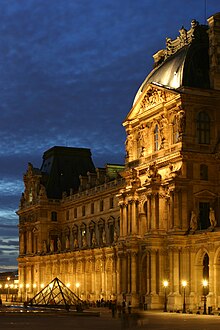
An art museum or art gallery is a building or infinite for the display of fine art, usually from the museum's own collection. It might be in public or private ownership and may be accessible to all or take restrictions in place. Although primarily concerned with visual art, art museums are frequently used as a venue for other cultural exchanges and creative activities, such as lectures, functioning arts, music concerts, or poesy readings. Art museums also ofttimes host themed temporary exhibitions, which often include items on loan from other collections.
Terminology [edit]

An institution dedicated to the display of art can be called an fine art museum or an art gallery, and the two terms may exist used interchangeably.[1] [2] [3] This is reflected in the names of institutions around the earth, some of which are called galleries (e.g. the National Gallery and Neue Nationalgalerie), and some of which are chosen museums (including the Metropolitan Museum of Art, the Museum of Mod Fine art, and Japan'southward National Museum of Western Fine art).
The phrase 'art gallery' can also be used for businesses which display art for sale, but these are not art museums.[two]
History [edit]
Private collections [edit]
Throughout history, large and expensive works of art have more often than not been commissioned by religious institutions or political leaders and been displayed in temples, churches, and palaces. Although these collections of fine art were not open to the full general public, they were often made available for viewing for a section of the public. In classical times, religious institutions began to function as an early on class of art gallery. Wealthy Roman collectors of engraved gems (including Julius Caesar) and other precious objects often donated their collections to temples. It is unclear how easy information technology was in practice for the public to view these items.

In Europe, from the Late Medieval period onwards, areas in royal palaces, castles, and large land houses of the social elite were oft made partially accessible to sections of the public, where fine art collections could be viewed. At the Palace of Versailles, entrance was restricted to people of certain social classes, wearing the proper clothes – the appropriate accessories (argent shoe buckles and a sword) could be hired from shops outside. The treasuries of cathedrals and big churches, or parts of them, were often set out for public display and veneration. Many of the grander English country houses could be toured by the respectable for a tip to the housekeeper, during the long periods when the family were not in residence.
Special arrangements were made to allow the public to see many royal or private collections placed in galleries, as with near of the paintings of the Orleans Collection, which were housed in a wing of the Palais-Royal in Paris and could be visited for nigh of the 18th century. In Italy, the art tourism of the Grand Tour became a major manufacture from the 18th century onwards, and cities fabricated efforts to make their key works accessible. The Capitoline Museums began in 1471 with a donation of classical sculpture to the urban center of Rome by the Papacy, while the Vatican Museums, whose collections are notwithstanding endemic by the Pope, trace their foundation to 1506, when the recently discovered Laocoön and His Sons was put on public display. A series of museums on different subjects were opened over subsequent centuries, and many of the buildings of the Vatican were purpose-built as galleries. An early on royal treasury opened to the public was the Green Vault of the Kingdom of Saxony in the 1720s.
Privately funded museums open to the public began to exist established from the 17th century onwards, often based effectually a collection of the cabinet of curiosities blazon. The first such museum was the Ashmolean Museum in Oxford, opened in 1683 to house and display the artefacts of Elias Ashmole that were given to Oxford University in a heritance.
Public museums [edit]

The Kunstmuseum Basel, through its lineage which extends dorsum to the Amerbach Cabinet, which included a drove of works by Hans Holbein the Younger and purchased by the metropolis of Basel in 1661,[4] is considered to be the commencement museum of art open to the public in the world.
In the 2d one-half of the 18th century, many private collections of art were opened to the public, and during and after the French Revolution and Napoleonic Wars, many royal collections were nationalized, even where the monarchy remained in place, equally in Spain and Bavaria.
In 1753, the British Museum was established and the Old Royal Library drove of manuscripts was donated to it for public viewing. In 1777, a proposal to the British authorities was put forward by MP John Wilkes to buy the art collection of the belatedly Sir Robert Walpole, who had amassed i of the greatest such collections in Europe, and house information technology in a specially built wing of the British Museum for public viewing. Later much debate, the idea was eventually abandoned due to the nifty expense, and twenty years later, the drove was bought by Tsaritsa Catherine the Great of Russian federation and housed in the Land Hermitage Museum in Saint Petersburg.[v]
The Bavarian royal collection (now in the Alte Pinakothek, Munich) was opened to the public in 1779 and the Medici collection in Florence around 1789[half dozen] (as the Uffizi Gallery). The opening of the Musée du Louvre during the French Revolution in 1793 as a public museum for much of the former French royal drove marked an of import phase in the development of public admission to art by transferring the ownership to a republican country; but it was a continuation of trends already well established.[7]
The building now occupied by the Prado in Madrid was congenital before the French Revolution for the public brandish of parts of the royal art collection, and like royal galleries were opened to the public in Vienna, Munich and other capitals. In Slap-up United kingdom, however, the corresponding Royal Collection remained in the private hands of the monarch, and the first purpose-congenital national art galleries were the Dulwich Pic Gallery, founded in 1814 and the National Gallery, London opened to the public a decade later in 1824. Similarly, the National Gallery in Prague was not formed by opening an existing royal or princely fine art drove to the public, just was created from scratch as a joint projection of some Czech aristocrats in 1796.
The Corcoran Gallery of Fine art in Washington, D.C. is by and large considered to accept been the beginning art museum in the United States.[8] It was originally housed in the Renwick Gallery, congenital in 1859. At present a part of the Smithsonian Institution, the Renwick houses William Wilson Corcoran'south collection of American and European art. The edifice was designed by James Renwick, Jr. and finally completed in 1874.[9] [10] It is located at 1661 Pennsylvania Artery NW.[11] Renwick designed it afterwards the Louvre'south Tuileries add-on.[12] At the time of its construction, it was known as "the American Louvre".[13] [14]
University museums and galleries [edit]

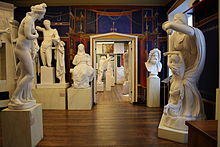
Academy art museums and galleries constitute collections of fine art developed, owned, and maintained by all kinds of schools, community colleges, colleges, and universities. This phenomenon exists in the Westward and E, making it a global practice. Although easily overlooked, there are over 700 academy fine art museums in the US solitary. This number, compared to other kinds of art museums, makes university art museums mayhap the largest category of art museums in the land. While the first of these collections tin can be traced to learning collections adult in art academies in Western Europe, they are now associated with and housed in centers of higher education of all types.
Galleries as a specific section in museums [edit]

The discussion gallery being originally an architectural term,[15] the display rooms in museums are ofttimes called public galleries. As well oftentimes, a serial of rooms dedicated to specific historic periods (east.g. Ancient Egypt) or other significant themed groupings of works (e.k. the drove of plaster casts as in the Ashmolean Museum) inside a museum with a more varied drove are referred to every bit specific galleries, e.g. Egyptian Gallery or Cast Gallery.
Visual art not shown in a gallery [edit]
Works on paper, such as drawings, pastels, watercolors, prints, and photographs are typically not permanently displayed for reasons of conservation. Instead, public access to these materials is provided past a dedicated print room located within the museum. Murals or mosaics ofttimes remain where they have been created (in situ), although many have likewise been removed to galleries. Various forms of 20th-century fine art, such equally country art and performance fine art, also usually exist outside a gallery. Photographic records of these kinds of fine art are often shown in galleries, yet. Nearly museums and big art galleries ain more works than they have room to display. The rest are held in reserve collections, on or off-site.
Similar to an art gallery is the sculpture garden (or "sculpture park"), which presents sculpture in an outdoor infinite. Sculpture installation has grown in popularity, whereby sculptures are installed in open spaces during temporary events like festivals.
Compages [edit]

Most larger paintings from about 1530 onwards were designed to be seen either in churches or (increasingly) palaces, and many buildings congenital as palaces now role successfully as art museums. Past the 18th century additions to palaces and land houses were sometimes intended specifically as galleries for viewing art, and designed with that in mind. The architectural form of the entire building solely intended to be an art gallery was arguably established by Sir John Soane with his pattern for the Dulwich Picture Gallery in 1817. This established the gallery as a series of interconnected rooms with largely uninterrupted wall spaces for hanging pictures and indirect lighting from skylights or roof lanterns.
The late 19th century saw a boom in the building of public art galleries in Europe and America, becoming an essential cultural feature of larger cities. More art galleries rose upward aslope museums and public libraries as part of the municipal bulldoze for literacy and public education.
Over the center and late twentieth century, before architectural styles employed for fine art museums (such every bit the Beaux-Arts style of the Metropolitan Museum of Art in New York City or the Gothic and Renaissance Revival compages of Amsterdam's Rijksmuseum) succumbed to modern styles, such as Deconstructivism. Examples of this trend include the Guggenheim Museum in New York City past Frank Lloyd Wright, the Guggenheim Museum Bilbao past Frank Gehry, Centre Pompidou-Metz by Shigeru Ban, and the redesign of the San Francisco Museum of Modernistic Art past Mario Botta. Some critics[ which? ] argue these galleries defeat their purposes considering their dramatic interior spaces distract the eye from the paintings they are supposed to exhibit.
Cultural aspects [edit]
Museums are more than than just mere 'stock-still structures designed to house collections.' Their purpose is to shape identity and retentiveness, cultural heritage, distilled narratives and treasured stories.[16] Many art museums throughout history accept been designed with a cultural purpose or been bailiwick to political intervention. In item, national art galleries have been thought to incite feelings of nationalism. This has occurred in both democratic and non-autonomous countries, although authoritarian regimes have historically exercised more than control over administration of art museums. Ludwig Justi was for example dismissed equally director of the Alte Nationalgalerie (Old National Gallery) in Berlin in 1933 by the new Nazi authorities for non being politically suitable.[17]
The question of the place of the fine art museum in its community has long been under debate. Some see art museums equally fundamentally elitist institutions, while others see them every bit institutions with the potential for societal education and uplift. John Cotton wool Dana, an American librarian and museum director, as well as the founder of the Newark Museum, saw the traditional art museum as a useless public institution, one that focused more than on fashion and conformity rather than education and uplift. Indeed, Dana's ideal museum would be i best suited for active and vigorous use by the boilerplate citizen, located near the center of their daily motility. In addition, Dana's conception of the perfect museum included a wider variety of objects than the traditional fine art museum, including industrial tools and handicrafts that encourage imagination in areas traditionally considered mundane. This view of the art museum envisions it as one well-suited to an industrial world, indeed enhancing it. Dana viewed paintings and sculptures as much less useful than industrial products, comparison the museum to a department store. In addition, he encouraged the active lending-out of a museum'south nerveless objects in order to raise education at schools and to assist in the cultural development of individual members of the customs. Finally, Dana saw branch museums throughout a urban center as a practiced method of making sure that every citizen has access to its benefits. Dana's view of the ideal museum sought to invest a wider variety of people in it, and was self-consciously not elitist.[18]
Since the 1970s, a number of political theorists and social commentators accept pointed to the political implications of art museums and social relations. Pierre Bourdieu, for instance, argued that in spite the apparent liberty of option in the arts, people'southward artistic preferences (such as classical music, stone, traditional music) strongly tie in with their social position. And then chosen cultural capital is a major gene in social mobility (for example, getting a higher-paid, higher-status job). The statement states that certain art museums are aimed at perpetuating aristocratic and upper class ethics of taste and excludes segments of guild without the social opportunities to develop such interest. The fine arts thus perpetuate social inequality past creating divisions betwixt different social groups. This argument as well ties in with the Marxist theory of mystification and elite culture.[xix]
Furthermore, sure art galleries, such as the National Gallery in London and the Louvre in Paris are situated in buildings of considerable emotional impact. The Louvre in Paris is for instance located in the former Majestic Castle of the ancient regime, and is thus clearly designed with a political agenda. It has been argued that such buildings create feelings of subjugation and adds to the mystification of fine arts.[twenty] Research suggests that the context in which an artwork is being presented has significant influence on its reception by the audience, and viewers shown artworks in a museum rated them more highly than when displayed in a "laboratory" setting[21]
Online museums [edit]
Museums with major web presences [edit]
Most fine art museums have only express online collections, but a few museums, as well every bit some libraries and authorities agencies, have adult substantial online catalogues. Museums, libraries, and authorities agencies with substantial online collections include:
- The British Museum has over 4,000,000 objects of all types available online, of which ane,018,471 have one or more images (as of June 2019).[22]
- Library of Congress, prints (C19 on) and photographs drove (several million entries).[23]
- Metropolitan Museum of Fine art has "406,000 hi-res images of public-domain works from the collection that can exist downloaded, shared, and remixed without restriction".[24]
- Rijksmuseum has 399,189 objects available online, of which 153,309 have one or more images.[25]
- National Portrait Gallery, with over 215,000 works, 150,000 of which are illustrated, including paintings, prints and photographic portraits.[26]
- MOMA (Museum of Modernistic Art), with holdings that include more than 150,000 individual pieces in addition to approximately 22,000 films.
- Boston Museum of Fine Arts, with over 330,000 works, most with images. Good for prints.
- Fine Fine art Museums of San Francisco, with over 85,000 works.
- Harvard Art Museums, with over 233,000 works online.[27]
- Louvre, with over 80,000 works in various databases, with a large number of images, also as another 140,000 drawings.[28]
- National Gallery of Art, with over 108,000 works catalogued, though with merely 6,000 images.[29]
- (in French) The Mona Lisa Database of French Museums – Joconde *(from the French Ministry of Culture)
- Gallery Photoclass South Korea Fine art Gallery – since 2002
- Museum of Art & Photography (MAP), Bengaluru, India, with over 18,000+ artefacts online, including paintings, photographs, textiles, sculptures and prints.
Online art collections [edit]
There are a number of online fine art catalogues and galleries that have been developed independently of the back up of any private museum. Many of these, like American Art Gallery, are attempts to develop galleries of artwork that are encyclopedic or historical in focus, while others are commercial efforts to sell the work of contemporary artists.
A express number of such sites have independent importance in the art world. The large auction houses, such as Sotheby'southward, Bonhams, and Christie's, maintain large online databases of fine art which they have auctioned or are auctioning. Bridgeman Fine art Library serves as a key source of reproductions of artwork, with admission limited to museums, art dealers, and other professionals or professional organizations.
Folksonomy [edit]
There are also online galleries that have been developed past a collaboration of museums and galleries that are more interested with the categorization of art. They are interested in the potential use of folksonomy inside museums and the requirements for mail-processing of terms that have been gathered, both to test their utility and to deploy them in useful ways.
The steve.museum is one example of a site that is experimenting with this collaborative philosophy. The participating institutions include the Guggenheim Museum, the Cleveland Museum of Art, the Metropolitan Museum of Art, and the San Francisco Museum of Mod Art.
Museum lists [edit]
- List of museums (major Wikipedia folio, listing links to manufactures on many specific museums, worldwide, sorted by country)
- List of about visited museums
- List of well-nigh visited fine art museums
- List of well-nigh visited museums by region
- List of largest art museums in the world
International and national lists [edit]
- Earth: Earth Heritage Site (southward) (per UNESCO)
- World (mod art): Museums of modern art
- Latin America: Museums in Latin America, on the website of the Latin American Network Data Middle (LANIC) of the Academy of Texas at Austin
- Us: Category:Institutions accredited by the American Alliance of Museums, alphabetical listing with links.
- United states of america: Fine art MUSEUMS, ART CENTERS, and NON-Turn a profit ART ORGANIZATIONS web page, sorted past state, on the website Art Collecting.com.
- Usa: Museums page, listing (with links) the national museums of the United States, in the "History, Arts, and Civilization" subsection of the "Citizens" section of the U.S. federal authorities'south general information website USA.gov
Local expanse lists [edit]
Major European cities [edit]
- List of museums in Berlin
- List of museums in London
- Listing of museums in Paris
- List of museums in Rome
Northward American local areas [edit]
- List of museums in Washington, D.C., United States
- Listing of museums in San Francisco, California, United States
- List of museums in Los Angeles, California, U.s.a.
- List of museums in Massachusetts, United states of america
- Listing of museums in New York Metropolis, The states
- List of museums in Toronto, Canada
Organizations [edit]
There are relatively few local/regional/national organizations defended specifically to fine art museums. Near art museums are associated with local/regional/national organizations for the arts, humanities or museums in general. Many of these organizations are listed as follows:
International and topical organizations [edit]
- UNESCO – the United nations Educational, Scientific and Cultural Organization—the leading global organization for the preservation and presentation of world cultures and arts.
- International Quango of Museums
- Association of Art Historians
- Clan of Art Museum Curators
- Association of Art Museum Directors
- Independent Curators International
- International Association of Curators of Contemporary Art (IKT)
- Higher Fine art Association (CAA)
- Minor Museum Association, an all-volunteer organization serving small museums in the mid-Atlantic region and beyond.
- N American Reciprocal Museum Clan (NARM)
- The Artists' Materials Eye: An practical research organization at Carnegie Mellon University dedicated to helping museums, libraries, and archives amend the means of caring for their collections.
- International Eye for the Study of the Preservation and Restoration of Cultural Property (ICCROM): an intergovernmental organization dedicated to the conservation of cultural heritage.
- International Institute for Conservation of Historic and Artistic Works (IIC)
National organizations [edit]
- Australia: Australian Museums and Galleries Association
- Canada: Canadian Art Museum Directors Organization (CAMDO)
- Canada: Canadian Museums Association
- Japan: Nihon Association of Art Museums (English language page)
- Nippon: Japanese Clan of Museums (English linguistic communication page)
- U.s.a.: American Alliance of Museums, formerly the American Association of Museums
- U.s.a.: American Federation of Arts
- The states: National Art Didactics Association, and specifically their Museum Education Sectionalization
- U.s.: American Institute for Conservation of Historic and Creative Works (AIC)
- Uk: The Museums Association (MA) is a professional person membership organisation based in London for museum, gallery, and heritage professionals, museums, galleries and heritage organisations, and companies that work in the museum, gallery, and heritage sector of the United Kingdom. It besides offers international membership. Started in 1889, it is the oldest museum clan in the world, and has over 5,000 individual members, 600 institutional members, and 250 corporate members.
Other organizations (for multiple museums) [edit]
Regional, provincial, and state museum organizations [edit]
- Canada, Ontario: Ontario Museum Association and Ontario Association of Art Galleries
- United States, western states: Western Museums Association
- United states of america, western states: Museums W Consortium, an clan of 13 museums of the American Due west.
- Usa, western states: Western Clan for Art Conservation (WAAC)
- Usa, California: California Association of Museums
- United States, Florida: Florida Art Museum Directors Association—an affiliate of the Florida Association of Museums
District, local and customs museum organizations [edit]
- U.s.a., Washington DC: Smithsonian Institution, the official national museum, and controlling organization for well-nigh major art and cultural museums in Washington, D.C., national museums with major art collections, as well every bit other national historic and cultural facilities nationwide. The Smithsonian likewise—directly or indirectly, and through traveling exhibits—coordinates some federal government support of museums (art and other), nationally. Also partners with many museums throughout the United states of america, each designated equally a "Smithsonian Affiliate" institution.
- United States, Florida, Miami Miami Art Museums Alliance
- United States, New United mexican states, Taos: Taos art colony
- United states of america, New York, New York City: Art Museum Partnership
- United States, New York, New York City: Museums Council of New York City
- U.s., Texas, Houston: Houston Museum District Association
See also [edit]
- Fine art exhibition
- Artist cooperative
- Artist-run initiative
- Artist-run infinite
- Arts centre
- Contemporary art gallery
- List of largest art museums
- List of most visited art museums
- List of national galleries
- Pop-up exhibition
- Vanity gallery
- Virtual museum
References [edit]
- ^ "New guidance for reopening of museums, galleries and the heritage sector". GOV.UK . Retrieved 30 August 2021.
- ^ a b "fine art gallery". dictionary.cambridge.org . Retrieved thirty Baronial 2021.
- ^ "Definition of GALLERY". world wide web.merriam-webster.com . Retrieved 30 Baronial 2021.
- ^ Dieffenbacher, Christoph. "Geschichte - Vom Geld und von der Kunst". St.Galler Tagblatt (in German language). Retrieved 3 May 2021.
- ^ Moore, Andrew (2 Oct 1996). "Sir Robert Walpole'due south pictures in Russia". Magazine Antiques. Archived from the original on 10 December 2008. Retrieved fourteen Oct 2007.
- ^ "Galleria degli Uffizi, Florence". Retrieved 17 December 2012.
- ^ Berger, Robert W. (1999). Public Admission to Fine art in Paris: A Documentary History from the Middle Ages to 1800. Penn Land Press. pp. 281–283. ISBN978-0-271-04434-7. Archived from the original on 5 August 2019. Retrieved 28 May 2018.
- ^ "Renwick Gallery". Smithsonian Institution.
- ^ Yardley, William. "Renwick Gallery of the Smithsonian American Art Museum". The Washington Post. Archived from the original on 12 February 2011. Retrieved xviii July 2013.
- ^ "Renwick Gallery of the Smithsonian American Fine art Museum". Frommers. Retrieved 18 July 2013.
- ^ Hours and Directions. Smithsonian American Fine art Museum. Retrieved ix September 2013.
- ^ Boyle, Katherine (18 February 2013). "Renwick modeled it after the Louvre's Tuileries addition". The Washington Postal service . Retrieved 18 July 2013.
- ^ "Renwick Gallery Review". Fodors. Retrieved 18 July 2013.
- ^ "Smithsonian Plans Overhaul of D.C.'south Renwick Gallery". Associated Press. 19 February 2013. Retrieved xviii July 2013.
- ^ John Fleming/Hugh Accolade/Nikolaus Pevsner, Dictionary of Architecture, Penguin Books, 4th ed. 1991, s.v. Gallery.
- ^ Procter, Alice (2020). The Whole Picture: The colonial story of the fine art in our museums & why nosotros demand to talk about it. Cassell. pp. 9–18.
- ^ Peter-Klaus Schuster: Die Alte Nationalgalerie. DuMont, Köln 2003, ISBN 3-8321-7370-6.[ page needed ]
- ^ John Cotton fiber Dana, A plan for a new museum, the kind of museum it will profit a city to maintain (1920)
- ^ P., Bourdieu, Distinction (1979), translated into English by R., Overnice (1984), ISBN 0-7100-9609-7. Especially chapter 1 "Aristochracy of Culture".
- ^ Le Palais-Royal des Orléans (1692–1793): Les travaux entrepris par le Régent at the Wayback Machine (archived 7 July 2007).
- ^ Susanne Grüner; Eva Specker & Helmut Leder (2019). "Effects of Context and Genuineness in the Experience of Fine art". Empirical Studies of the Arts. 37 (2): 138–152. doi:10.1177/0276237418822896. S2CID 150115587.
- ^ "British Museum collection database online". Britishmuseum.org. Retrieved seven June 2019. ; "There are currently 2,335,338 records bachelor, which stand for more 4,000,000 objects. 1,018,471 records take i or more images".
- ^ "Prints & Photographs Online Itemize". Library of Congress. Retrieved 16 June 2012.
- ^ MMA site, accessed 7 June 2019
- ^ Search the collection, Rijksmuseum. Retrieved on 11 January 2014.
- ^ "People & Portraits – National Portrait Gallery". www.npg.org.uk.
- ^ website, 6 June 2019
- ^ "Databases | Louvre Museum". Louvre.fr. Archived from the original on 7 October 2011. Retrieved 16 June 2012.
- ^ "National Gallery of Fine art – The Collection". Nga.gov. Retrieved 16 June 2012.
Further reading [edit]
- Lindsay, David Alexander Edward (1911). . Encyclopædia Britannica. Vol. 19 (11th ed.). pp. sixty–64.
- Saumarez Smith, Charles (2021). The fine art museum in modern times. London: Thames & Hudson. ISBN978-0-500-02243-6. OCLC 1233310517.
Source: https://en.wikipedia.org/wiki/Art_museum
0 Response to "First Art Gallery What Was the First Art Gallery"
Post a Comment